
Copyright@Zeal Okogeri
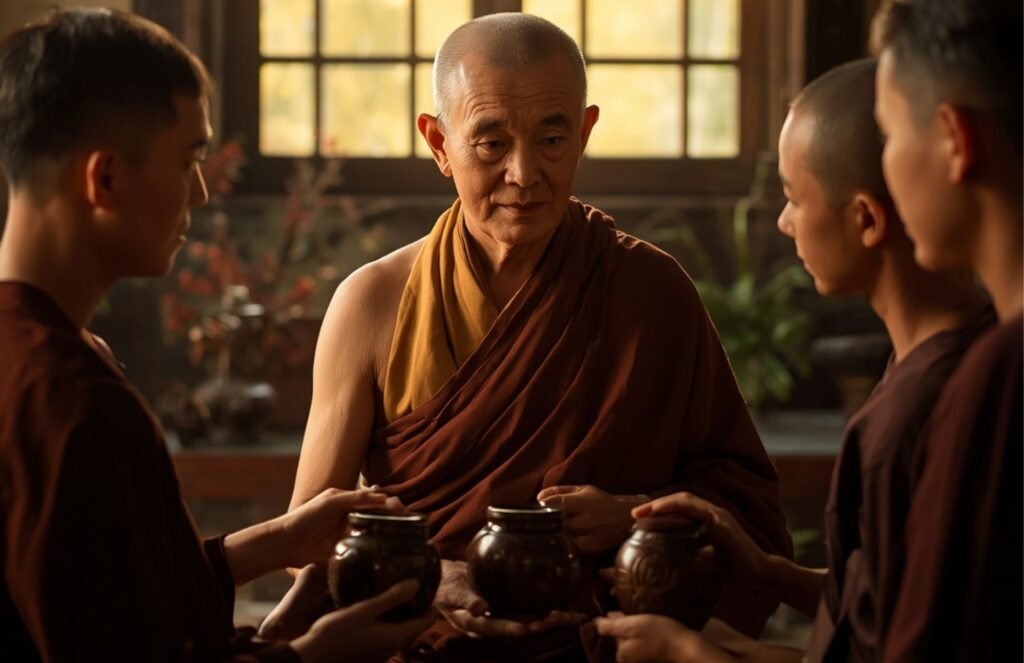
Deep in the mountains, an elderly spiritual master lived in a modest temple with his three closest disciples. For many years, they had studied under him, learning the ways of love, wisdom, compassion, and inner peace.
As the master grew weaker with age, the disciples began to wonder who would one day carry on his teachings and guide the community after he was gone.
One evening, the master called the three disciples into his room. On the table before him were three identical ceramic jars, each tightly sealed with wax.
“My time here is growing short,” the master said gently. “Before I depart, I wish to know who among you understands the heart of my teachings.”
He handed each disciple a jar.
“This jar contains my love for you,” he continued. “And love is the deepest truth I have tried to teach you. Go into the courtyard and show me how you will honor it.”
The first disciple received his jar with great reverence.
“The master’s love is sacred,” he thought. “I must protect it from the world, where it could be damaged or lost.”
He carried the jar to a hidden corner of the temple, wrapped it carefully in fine silk, and placed it inside a heavy iron chest. He locked the chest and remained nearby throughout the night, guarding it from every possible danger.
The second disciple received his jar with great joy.
“The master’s love is beautiful,” he thought. “It deserves to be honored and celebrated.”
He placed his jar on the main altar, lit fragrant incense, and surrounded it with beautiful orchids. He invited the villagers into the temple and led them in songs of praise. Everyone admired the altar and marveled at how beautifully the jar had been presented.
The third disciple held his jar quietly and looked toward the village below the mountain.
He saw farmers working beneath the hot sun. He saw hungry children. He saw tired mothers carrying water. He saw an old man struggling to walk and a stray dog lying wounded near the roadside.
He thought for a moment about his master’s teachings.
Then he smiled.
“Love is not something to be hidden away,” he thought. “Nor is it something to be admired from a distance. Love must be lived.”
He broke the wax seal and opened the jar.
To his surprise, it was filled to the brim with pure, clear water from a sacred spring.
He carried the jar down the mountain.
Along the way, he gave a cup of water to a farmer who was exhausted from working in the fields. He knelt beside the wounded dog and gently washed its wounds. When he reached the village square, he poured the remaining water around the roots of a dying fruit tree.
Then he returned to the temple.
His jar was empty.
The next morning, the master called the three disciples before him.
The first disciple proudly showed him the iron chest.
“I protected your love from everything that might harm it,” he said.
The master looked at him with compassion.
“You protected the jar,” he said, “but you did not allow its gift to touch a single life. Love that is locked away out of fear cannot fulfill its purpose.”
The second disciple pointed proudly toward the beautifully decorated altar.
“I honored your love,” he said. “Everyone saw its beauty.”
The master looked at the flowers, the incense, and the jar.
“You honored the symbol of love,” he said gently, “but love is not fulfilled by admiration alone. What good is love if it never reaches the heart of another?”
Finally, the third disciple stepped forward.
He held out his empty jar. It was still damp from the water he had poured away.
“Master,” he said quietly, “I have nothing left to show you. I poured it all into the world.”
The master smiled. His eyes filled with tears.
He reached for his walking staff and placed it in the disciple’s hands.
“You have understood,” he said.
“Love is the only resource in the universe that multiplies when you give it away. It is not something we possess; it is something we do.”
He looked at the empty jar and then at his disciple.
“By emptying your jar, you have filled the world. And in giving away what you were given, you have truly received its meaning.”
The disciple bowed his head.
And the master knew that his teaching would continue, not merely in words, but in the lives touched by love.
Spiritual Insight
We all carry something precious within us. It may be love, kindness, wisdom, compassion, forgiveness, or a gift that could make another person’s life a little better. Yet knowing what we carry is not enough. The deeper question is what we do with it.
The first disciple reminds us of what can happen when we protect everything we value so carefully that we never allow it to be used. Fear can persuade us that keeping our gifts safe is the same as honoring them. But a gift that is never shared remains only a possibility.
The second disciple reminds us that it is also possible to admire goodness without living it. We can speak beautifully about love, peace, compassion, and kindness. We can surround ourselves with beautiful symbols of spirituality. But wisdom becomes meaningful when it moves from our thoughts and words into our lives.
The third disciple understood something deeper. He did not try to preserve the water. He allowed it to become useful. A thirsty person drank it. A wounded creature received care. A dying tree was given another chance to live.
This is why love requires demonstration. We can speak about love, declare it, promise it, and even feel it deeply within our hearts. But love becomes most powerful when it takes form through what we do. A loving heart reaches out. It gives. It comforts. It protects. It forgives. It serves.
The same is true of wisdom. When we share what we have learned, we do not become less wise. When we offer kindness, we do not become less kind. When we bring peace into another person’s life, we do not lose our own peace.
There is also a lesson here about spiritual practice. What we receive through meditation, prayer, contemplation, or life experience is not meant to remain locked inside us. The peace we discover within can become patience with another person. The compassion we awaken within can become a helping hand. The wisdom we gain can become understanding rather than judgment.
The empty jar is therefore not a symbol of loss.
It is a symbol of fulfillment.
Perhaps the purpose of what we receive is not to possess it, but to pass it on.
Love is not merely something we feel. Love is something we demonstrate.
And when we allow love to flow through us and into the lives of others, we discover that the jar we thought we were emptying was never truly ours to keep.
Love becomes most alive when it is expressed.
About the Author
Dr. Zeal Okogeri is a spiritual teacher, storyteller, and author who continues the timeless tradition of using stories to awaken the heart and reveal life’s deepest truths. Like the great wisdom teachers throughout history, he conveys spiritual principles not through lectures or rigid instruction, but through timeless stories that invite reflection, contemplation, and personal discovery.
Rather than telling readers what to believe, Dr. Zeal trusts each person to discern truth through the wisdom found within every story. His writings gently encourage the cultivation of kindness, love, peace, compassion, and the inner wisdom that transforms lives.
Dr. Zeal is the author of You Can Never Go Wrong By Being Kind. Through his books, guided meditations, retreats, and spiritual teachings, he inspires people to look within, awaken to their true nature, and live with greater love, peace, and purpose.
To explore more of his work and guided meditations, visit DrZeal.org
“The deepest truths are rarely taught. They are discovered.”