
Copyright@Zeal Okogeri
Long ago, in ancient Greece, there was born a child named Narcissus, the son of the river god Cephissus and the nymph Liriope.
From the moment he entered the world, people noticed his extraordinary beauty. His parents, curious about his future, sought the wisdom of the blind seer Teiresias.
The seer gave a mysterious answer:
“He will live a long life, but only if he never comes to know himself.”
No one understood the meaning of the prophecy.
How could knowing oneself be dangerous? Is self-awareness not a gift?
Years passed, and Narcissus grew into a young man whose beauty was admired throughout the land. People were captivated by his radiant face, his graceful presence, and his striking appearance.
Many fell in love with him, but Narcissus rejected them all. He became so attached to his own perfection that he could no longer recognize the beauty, kindness, and love offered by others.
Among those who loved him was a gentle forest nymph named Echo. She saw beyond his outward appearance and longed to know his heart. But Narcissus was unable to see the love before him. He was too absorbed in the image others had created of him.
With a broken heart, Echo slowly faded away until only her voice remained.
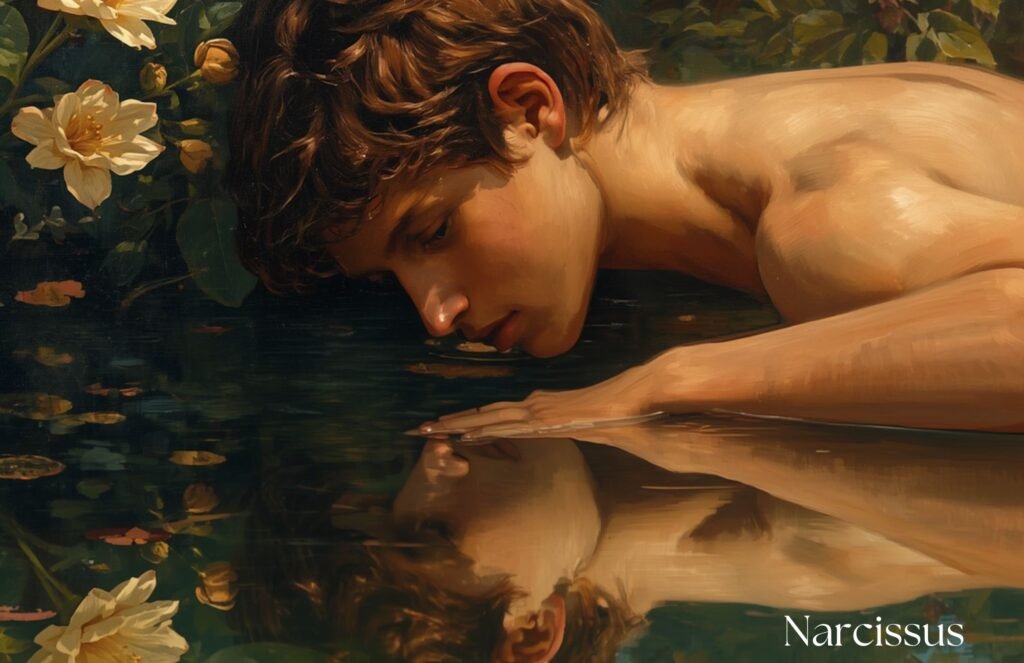
One day, while wandering alone through the forest, Narcissus discovered a clear freshwater lake hidden among the trees. The surface was perfectly still, reflecting the sky and surrounding forest like a polished mirror.
When he looked into the water, he saw a face he had never seen before.
For the first time, he saw himself.
He did not see himself through the words of others. He did not hear the voices that praised his beauty. He encountered his own reflection directly, and he was overwhelmed by what he saw.
A young man of extraordinary beauty gazed back at him.
Narcissus was captivated.
He did not realize that the beauty before him was his own reflection.
Day after day, he returned to the clear freshwater lake. He reached toward the beautiful image, but whenever his hands touched the water, the reflection disappeared into ripples. When the surface became still again, the beautiful face returned.
The reflection showed him beauty, but it could not give him love. It showed him an image, but it could not reveal his soul.
Narcissus had spent his life surrounded by admiration, yet he had never discovered the deeper beauty within himself.
Unable to leave the lake, he remained there until his body grew weak and his life slowly faded away.
From the place where he rested, a beautiful flower grew, forever carrying his name. It was called the narcissus.
After Narcissus was gone, the forest grew quiet. The clear freshwater lake where he had spent so many hours seemed filled with sorrow.
Its waters became salty, as though filled with tears.
The spirits of the forest approached the lake and asked, “Why do you grieve? Did you not watch Narcissus spend his days admiring his own beauty?”
The lake remained silent for a long time.
Finally, the lake asked, “Was Narcissus truly so beautiful?”
“Who better to know than you?” the spirits said. “He spent so much time beside your waters, admiring his own beauty.”
The lake was silent.
Then it answered softly, “I never knew Narcissus was beautiful.”
The spirits were surprised.
The lake continued, “Whenever Narcissus knelt beside my waters, I looked into his eyes and saw a reflection of my own beauty.”
The forest became still.
The lake whispered, “I do not grieve because Narcissus was beautiful. I grieve because, through him, I discovered a beauty within myself that I had never known.”
And the spirits of the forest carried away the wisdom of the lake.
For even in a story about self-obsession, there was a hidden truth: every encounter is a reflection. What we see in others often reveals something within ourselves.
Spiritual Insight
The direct message of this story is simple:
Appreciate your outer beauty, but build your foundation on the beauty that time cannot take away.
The story of Narcissus is often told as a warning against vanity, but its deeper lesson is about where we find our true worth.
There is nothing wrong with appreciating our outer beauty. Our bodies are precious gifts, and caring for ourselves with love and respect is an expression of gratitude. Beauty can bring joy. It can inspire us and allow us to appreciate the wonder of life.
But outer beauty is temporary.
The face we admire today will change with time. The strength of youth will eventually soften. The reflection in the mirror will slowly become different.
This is not a tragedy. It is the natural journey of being human.
The suffering begins when we build our entire identity on something that was never meant to remain the same. If our sense of worth depends only on our appearance, our youth, or the admiration of others, we may struggle when those things begin to fade.
This is the deeper meaning behind the prophecy of Narcissus.
The seer said that Narcissus would live a long life if he never came to know himself. The danger was not simply seeing his reflection. The danger was discovering only one part of himself and believing it was the whole truth.
Narcissus saw his face, but he did not discover his heart. He saw his outer beauty, but he did not cultivate the inner beauty that would have sustained him throughout life.
True self-knowledge is not found only in the mirror. It is found in discovering the qualities of the soul.
Kindness. Compassion. Wisdom. Love. Patience. Humility. A peaceful heart.
These qualities do not diminish with age. They deepen.
A person who has cultivated inner beauty does not fear the passing of time, because they know their deepest worth was never found in the mirror. The body may change, but the light within can continue to shine brighter.
Narcissus searched for beauty in a reflection and lost himself. The wisdom of life invites us to look beyond the surface and discover the beauty that has always been within.
Outer beauty may fade with time, but inner beauty becomes more radiant with every passing year.
About the Author
Dr. Zeal Okogeri is a spiritual teacher, storyteller, and author who continues the timeless tradition of using stories to awaken the heart and reveal life’s deepest truths. Like the great wisdom teachers throughout history, he conveys spiritual principles not through lectures or rigid instruction, but through timeless stories that invite reflection, contemplation, and personal discovery.
Rather than telling readers what to believe, Dr. Zeal trusts each person to discern truth through the wisdom found within every story. His writings gently encourage the cultivation of kindness, love, peace, compassion, and the inner wisdom that transforms lives.
Dr. Zeal is the author of You Can Never Go Wrong By Being Kind. Through his books, guided meditations, retreats, and spiritual teachings, he inspires people to look within, awaken to their true nature, and live with greater love, peace, and purpose.
To explore more of his work and guided meditations, visit DrZeal.org
“The deepest truths are rarely taught. They are discovered.”